
AI visibility: How to check what AI assistants say about your SME
Use targeted queries to check how AI assistants describe your SME, which sources they rely on and where information needs correcting.
Read articleThe latest on AI governance, compliance, and enterprise security.
Use targeted queries to check how AI assistants describe your SME, which sources they rely on and where information needs correcting.
Read article
Whether AI improves collaboration depends on what happens after the answer: context, review, permissions and where results are saved.

A practical guide for Swiss SMEs to test how AI assistants describe their company, document the findings and correct factual errors.

An AI chat can read an invoice. It cannot move the case forward. Why we are building Hegyon around connected business processes, and what the 2026 ISG report describes.

How companies capture a flood of damage reports in minutes, route them through automated workflows and analyse every case, with the Forms module and Newsroom from hegyon.ai.

Sharing information is easy. Making sure it is read and confirmed is harder. How the Hegyon Newsroom makes internal communication visible, measurable and binding.

The Swiss QR-Bill is mandatory, but only the end of the story. How Swiss SMEs digitise quote, delivery note, invoice and payment, via a customer portal without login.

SMEs rarely have a contract manager, and that is exactly where the expensive mistakes happen. How an AI-supported contract management secures deadlines, makes risks visible and turns contracts into something you can query.

Does Swiss law prescribe an inventory-valuation method? No. What CO Art. 960c really requires, when FIFO and when the moving average fits, and what to watch for on consistency.

Fiduciaries juggle client mandates across tools that were never built for it. What matters in real multi-tenant software: isolation, clean export and one login instead of twenty.

Stored digitally doesn't mean audit-proof. What the Swiss Code of Obligations and the Business Records Ordinance (GeBüV) really require of SMEs, and how to tell whether your accounting will withstand an audit.

Bexio is ideal to start, but when does it become too narrow? 7 concrete signals that your SME needs a real ERP, and what to watch for in a Bexio alternative.

When key employees resign, the knowledge leaves with them — processes, customer context, edge cases that only existed in one head. How Swiss SMEs capture that knowledge continuously, instead of on the leaving day. The assistant documents along, a human decides what stays.

Why a small payroll error becomes expensive in a Swiss SME: payroll corrections, the annual salary statement, retroactive social-security deductions and pain.001 under control. The assistant prepares the payroll run, a human approves.

Reconcile CAMT.053 against open receivables automatically, match QR references, detect part payments: the practical guide to payment matching for Swiss SMEs. The assistant matches, the human resolves the exceptions.

Calculate default interest under OR Art. 104 correctly, document dunning stages cleanly, protect liquidity: the practical guide to dunning for Swiss SMEs. People decide, the assistant does the legwork.

An honest AI readiness assessment in 15 minutes. Five blocks, clear signals, no scoring — a practical check for Swiss SMEs from 20 to 250 employees.

In Swiss mechanical engineering, designers, service technicians and sales engineers spend 30 to 50 percent of their time on administration. Six concrete bottlenecks, quotations, service reports, multilingual documentation, CE conformity, spare parts, customs, and where an operational assistant realistically takes hold.

Swiss managers receive nearly 200 emails per week and meaningfully read only 12 percent of them. The 4-block framework that holds up in practice, and how to get the brief on the first morning, without a Custom-GPT setup or a four-week integration project.

Swiss hospitality runs 2026 with a labour cost ratio of around 40 centimes per franc of revenue, at a 3 centime net margin. The three AI use cases that, for the first time, deliver a clear ROI in DACH SMEs: voice reservations, forecast-driven shift planning, automated allergen management.

When the next RFP demands 'Swiss data residency', an architecture decision gets made that shapes the next five years. A decision tree that runs the three realistic options against the four constraints that hit consulting SMEs hardest, professional secrecy, time-to-value, TCO and AI roadmap.

An AI policy is not a compliance document for the intranet, it's a security instrument. Whoever hardens firewalls and backups but ignores Shadow AI is leaving today's biggest gap wide open. What an effective policy must regulate, and where it needs technical teeth.

Not every process belongs on the automation list. Pick the wrong ones and you burn time, money and your team's trust. A practical filter that helps Swiss SMEs find the right candidates, and spot the risky ones.

More tools did not lead to less friction, quite the opposite. How an AI Operational Assistant differs from a classical ERP, and why exactly that gap costs Swiss SMEs hours every day.

Microsoft 365 Copilot is a powerful productivity layer in Word, Excel, Outlook and Teams. When Swiss SMEs expect a corporate copilot for real business processes, a gap opens up, and in construction it becomes especially visible.

How Swiss SMEs introduce AI without losing the trust of their teams: change management, FADP, public-LLM risks, the EU AI Act and the employee-copilot approach for construction companies, laid out as a realistic six-to-twelve-week rollout plan.

Do you know what your foreperson, your project manager or your estimator is typing into ChatGPT, Claude or Gemini today? A practical roadmap for Swiss construction SMEs to roll out AI securely, in an integrated way, and in compliance, without leaking trade secrets to the competition.

Capture, GL coding, 4-eyes approval, Pain.001 payment run and CAMT.053 reconciliation, where the time really leaks in the Swiss accounts-payable loop, and how a preparing assistant gives 12 of 16 hours back.

Photo-to-booking in under ten seconds, automatic VAT recognition, Swiss expense categories, why expense reporting is the last Excel stronghold in the SME, and how AI is replacing it.

Ten safeguards against Shadow AI, Prompt Injection and RAG oversharing, aligned with revFADP, the EU AI Act and FINMA, plus the role of sovereign Swiss AI.

Short answer: yes, but only in the right business tiers with a signed DPA, EU/Switzerland data residency enabled, and a documented risk assessment. Here is what the Swiss revDSG, the EU AI Act and the Anthropic shift of 28 August 2025 mean for your SME.

AI in the enterprise saves up to 40% of time in office work. Why artificial intelligence is a genuine digital transformation, and how SMEs can adopt it successfully.

The real question isn't which retrieval architecture is best, it's how big, how dynamic, and how risk-exposed your enterprise knowledge is, and how much autonomy the system needs.

How Japan went from cautious adopter to AI superpower, and what its trillion-yen bets and shadow AI challenges mean for European enterprises navigating the AI governance era.

The EU AI Act is extraterritorial, phased deadlines are already live, and Switzerland has no horizontal AI law. For Swiss companies serving EU customers, the compliance clock is ticking, and 2027 is too late to start.

When employees start using ChatGPT with company data on private accounts, the question is no longer whether you need AI governance, but how fast you can implement it.

With the EU's highest GenAI adoption rate, a €556M supercomputer investment, and a national AI register setting the standard for transparency, Finland is proving that governance doesn't slow innovation, it accelerates it.

History doesn't repeat itself, but the patterns of employee resistance and acceptance do. Here's what four decades of workplace technology tell us about getting AI adoption right.

From risk classification to human oversight, a practical guide to meeting the EU AI Act's staggered obligations, and building governance that scales.

Prompt-to-app development is exploding. So are the data leaks. 38 million records exposed through Power Apps alone, 125 million through Firebase, 40% of AI-generated code found vulnerable. Here's why governance, not better prompts, is the answer.

Companies lose $31.5 billion annually to knowledge walkout. 80% of organizational knowledge exists only in people's heads. AI can now capture it, but only if the right governance architecture is in place.

39.7% of all AI interactions at work contain sensitive data. Most happen through personal accounts your IT team doesn't even know about. Here's what the 2023–2025 incident record reveals, and what to do about it.

Even if AI models stop outputting confidential data directly, their indirect answers reveal what they know. Current research shows this problem is fundamentally unsolvable, and that changes how enterprises should think about AI security.

Microsoft Copilot rollouts at BlackRock, Swiss Re, and Barclays reveal a pattern: the organizations that succeed with enterprise AI are the ones that put governance first, not last.
Seventeen months of writing, and the conversation in Swiss companies has moved. What that means for what this blog covers next.
Clients are starting to ask suppliers to use AI, or to prove they do not. Both requests can be unreasonable, and declining well is a skill worth having.
An open-weight preview appeared on Monday, ahead of a larger release later in the year. The distinction matters more than the model does.
Spring hiring season. One question separates people who use these tools well from people who have simply used them, and it is not a technical question.
Not a breach in the cinematic sense. A twenty-minute conversation about the three realistic scenarios, so that nobody has to work it out under pressure.
Machine translation is the most obviously useful AI task for a Swiss company, and the one where the quality difference between careless and careful use is largest.
One genuinely useful technical change, one international meeting that changed nothing, and guidance from Brussels that arrived exactly as described.
A larger client sends you a form asking about your use of AI. It will happen this year. Here is how to answer it in half an hour instead of a week.
Training courses do not work for this. What works is one person showing one other person a task they both already do.
Google released a refinement of Gemini 3 yesterday. Counting from November, the frontier has now produced four point releases and no new generation.
New Delhi is hosting this week, after Bletchley, Seoul and Paris. The declaration will not reach your company, but the direction of travel eventually will.
Larger context windows invite bigger pastes. Before that becomes a habit, it is worth knowing exactly where those documents go.
Davos found large companies full of them. Small companies have them too, and the reason they stall is identical and fixable.
Every Swiss SME has one document people keep asking questions about. Here is how to make it answerable, in an afternoon, without a project.
Anthropic released a model yesterday whose context window is five times larger than before. This is the most practically useful change in months, for one narrow reason.
The 2 February guidance arrived. As predicted, it requires nothing of a Swiss SME — but one part of it will quietly improve your life later this year.
No significant model launches, one forum in the Grisons, and a month in which the useful work was entirely internal.
Two things are due on 2 February, and one of them is genuinely useful. Neither requires anything of a Swiss SME.
Davos spent last week asking what AI spending produced. Here is how to answer that for a Swiss SME without a consultant and without pretending.
The forum is in the Grisons this week and the mood has changed. Last year it was panic about new models; this year boards are asking what the spending produced.
DeepSeek R1 appeared on 20 January 2025 and wiped hundreds of billions off technology stocks. Twelve months later, here is what it actually changed.
Several of your colleagues used AI properly for the first time over the holidays, at home, for something personal. That is an asset and it has a two-week shelf life.
When you connect an assistant to your files, it inherits somebody’s permissions. In most Swiss SMEs, nobody knows whose.
Four significant models arrived between November and December. January, with a quiet office, is the month to find out whether any of them is better for your work.
Most software contracts roll over on 1 January, when nobody is in the office. Here is how to find out what just happened, and what to do about it.
Whatever you plan for this year, it is blocked on a decision most Swiss SMEs have still not made. It takes one meeting and one sentence.
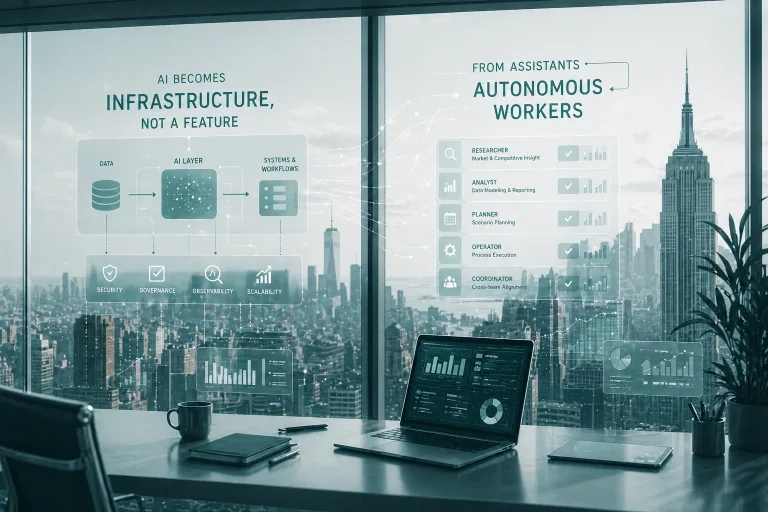
By the close of 2025 the AI conversation has shifted twice. First: AI stopped being a feature bolted onto products and started behaving like infrastructure, billed by the hour, depended on like a database, with capital expenditure that rivals national grids. Second: the systems themselves stopped being assistants and started being autonomous workers, with Claude Sonnet 4.5 sustaining 30-hour coding sessions on real tasks and the Model Context Protocol becoming the universal interface that lets agents call tools across vendors. For European enterprises, the consequences for procurement, security, and headcount are now operational.
Twelve months, dozens of launches, one regulatory retreat, and surprisingly few things a Swiss SME had to do differently.
Fourteen months of posts compressed into the order we would actually do things, for a Swiss SME that has done nothing yet.
Google made its fast, cheap model the default in its assistant yesterday. After a year of ever-larger launches, the direction has quietly reversed.
Two weeks of thin staffing is when the small things go wrong. Five checks, none of which takes longer than a coffee.
OpenAI released GPT-5.2 yesterday, reportedly after an internal alarm about Google. The competitive panic is more informative than the model.
Four dates get mentioned in AI compliance discussions. Only one of them is likely to require anything of a Swiss SME, and it is not the one you expect.
On-device models are the most over- and under-sold idea in this field at once. Here is the honest version of what a small local model can do.
Mistral released a new family on Tuesday, including a small model meant to run on ordinary devices. Both halves matter, for different reasons.
December has fewer meetings and no announcements that matter. That combination makes it the most productive month of the year for this subject.
The busiest month of announcements this year, and the one where the least changed for a company of thirty people.
The tools your staff use unofficially are usually harmless. There is one department where they are not, and it is the one nobody checks.
Anthropic released Claude Opus 4.5 yesterday, completing the set. The pattern of the last three weeks is more informative than any of the three models.
A dense fortnight of announcements produces a specific kind of bad decision. Here is what it looks like and how to avoid making it.
The Commission published a package yesterday that would push the high-risk obligations well past August 2026. A prediction made here in August has been overtaken by events.
Google released its new generation yesterday, a week after OpenAI’s update. For the first time the honest answer to “which is best” is “it depends what for”.
In a small company one person usually builds the automations. The risk is not that they leave. It is that nobody wrote down what they knew.
Not with benchmarks. With twenty of your own examples and a sheet of paper, which will tell you more than any published comparison.
OpenAI released an incremental update yesterday. The interesting part is that the numbering has slowed down, and that is worth reading as a signal.
Ten years of notes in your customer system are the one dataset that is yours alone. Almost nobody uses them, for one fixable reason.
Moonshot released a downloadable reasoning model yesterday. Reasoning used to be the thing the closed models kept for themselves.
The request will arrive, it will be enthusiastic, and the temptation is to say no. Four questions produce a better answer in ten minutes.
A month of one consistent theme, an anniversary, and a cloud outage that was more instructive than any of the launches.
OpenAI completed a corporate restructuring on Tuesday, with Microsoft holding a substantial minority stake. What a supplier’s ownership change does and does not mean to you.
Not a policy. A single page that answers the four questions somebody will ask you in the next twelve months, while you still remember the answers.
OpenAI released a web browser on Tuesday with the assistant built into it. It is a good product and it inherits every question from this month’s other posts at once.
Monday’s cloud outage took down a long list of services, AI assistants among them. The lesson is not about clouds. It is about what you do for the rest of the day.
A scanned PDF looks like a document to you and like a photograph to software. This is the single most common reason a promising automation stalls.
Anthropic released a smaller model yesterday. For most of what a company actually does, smaller is the right answer and almost nobody chooses it.
The first post here appeared on 13 October 2024 and asked where Swiss SMEs actually stood. A year later, the honest scorecard.
Apps running inside a chat window raise an old question in a new place. The app-store answer took fifteen years to arrive; this one has not arrived yet.
OpenAI’s developer conference on Monday pointed in one direction: the chat window wants to become the place you do things, not just ask things.
The word is about to be everywhere. It currently describes four quite different things, and only one of them needs your careful attention.
Not a strategy review. Three figures you can pull in twenty minutes that tell you whether your AI spending is doing anything.
Anthropic released Claude Sonnet 4.5 yesterday, closing a month whose most interesting release came from Lausanne and Zurich.
When a machine-assisted task fails in a company, the model is rarely the weakest link. Four more likely causes, in order of frequency.
Swiss companies are beginning to find AI wording in contracts their customers send them. Three shapes, and what each one actually asks of you.
Nvidia and OpenAI announced an infrastructure partnership on Monday. The number that matters to a Swiss SME is not the money — it is the electricity.
Most companies have been using these tools for about a year now. That is long enough for a list to have gone stale in three specific ways.
OpenAI released a coding-specific version of GPT-5 on Monday. Even if you never write software, the direction matters to you.
Budgets for next year are being written this month. Here is what belongs in that line, and the two numbers most companies forget.
Most failed automations were doomed at the choosing stage, not the building stage. These three questions take ten minutes and catch nearly all of them.
Alibaba previewed its largest model on Monday. The notable part is that the company built on open weights kept this one closed.
In most Swiss SMEs the honest answer is nobody, which is why the same question gets reopened every four months.
Tuesday’s Swiss model release prompts an obvious question. The answer is yes for one of the two sizes, and no for most companies regardless.
EPFL, ETH Zurich and the national supercomputing centre released Apertus today. For once, a model release that is genuinely a Swiss story.
A dense month that changed less than it appeared to. What to carry into September, in five lines.
The documents published this month are long, technical and mostly irrelevant to you. Four sections are not. Here is where to look.
V3.1 appeared on 21 August. Ten months into this blog, the interesting fact is no longer the model. It is how routine this has become.
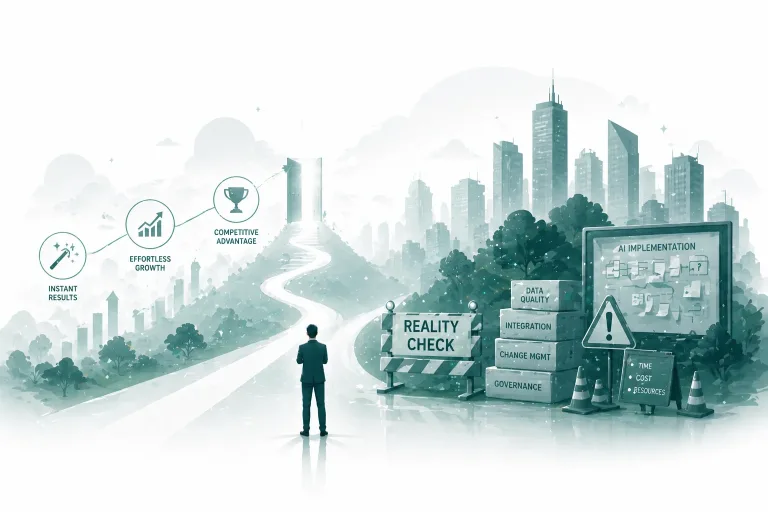
August 2025 produced three reality checks in close succession: MIT's NANDA project found roughly 95 percent of enterprise GenAI pilots return zero P&L impact, OpenAI's long-awaited GPT-5 landed as iteration rather than leap, and Apple's reasoning-model paper documented hard limits where today's models actually break. The era of treating AI as magic is closing, the era of treating it as real engineering is starting.
Not because AI is dangerous, but because some settings were switched on for you and do something you would not have chosen.
Swiss apprentices start next week. The tasks we used to give them to learn on are exactly the ones a machine now does in four seconds.
You bought it, announced it, and six weeks later usage is four people. The reason is almost never the reason given in the meeting.
GPT-5 replaced everything last week. Within days, OpenAI restored the previous model after a wave of complaints. There is a lesson in that for your own supplier planning.
August is a hiring month. Two paragraphs in your welcome pack will save a year of unclear expectations.
OpenAI released GPT-5 yesterday and routed everything through it automatically. The automatic routing is the part that affects how you budget.
Two downloadable models under a permissive licence, released yesterday alongside a Claude upgrade. The company that argued against this has changed position.
Last week this blog predicted an uneventful Monday. It was. But something did arrive, and it is worth knowing where to find it.
The general-purpose AI obligations take effect on Saturday. Based on what happened in February, here is a realistic forecast.
The White House released a 90-plus action plan on Wednesday, nine days before Europe’s next obligations bite. Swiss companies trade with both.
The instruction that works when you type it often fails when a colleague does. Four things that make the difference, and why this is documentation.
OpenAI put a general-purpose agent into ChatGPT last week. It clicks, fills forms and downloads files — on a subscription anyone in your company can buy.
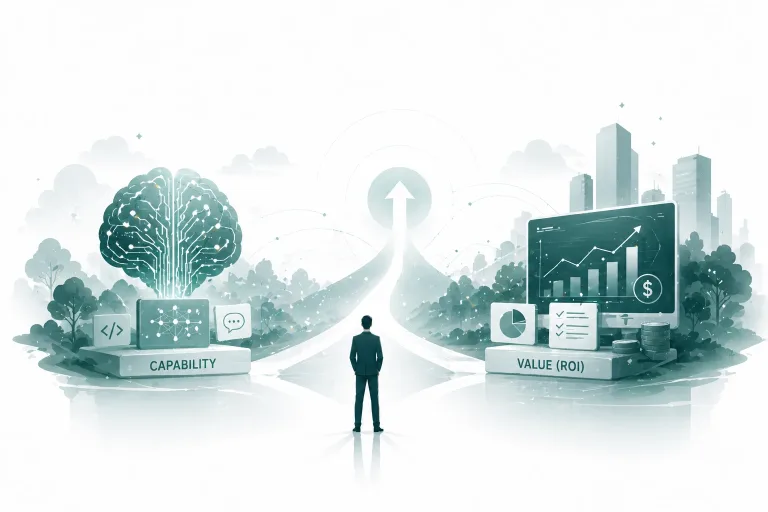
After two years of capability racing, H1 2025 has forced a different question on every enterprise AI program: where is the measurable return? Klarna walked back its AI customer-service push, Microsoft cut roughly 9,000 jobs while pouring billions into AI infrastructure, and McKinsey's 2025 data shows 78 percent adoption alongside stubbornly modest bottom-line impact. The capability era is closing; the value era is starting now.
If supplier invoices do not fit your company, this is the other one that works. Same method, different input, one extra hazard.
Published on 10 July after three drafts and about a thousand contributors. For a Swiss SME it confirms what arrives, and what does not.
Moonshot AI released Kimi K2 under an open licence this week. The headline number is not the interesting part.
xAI released Grok 4 today. The model is not the point. Four credible suppliers competing for the same customers is.
You are probably paying for three AI subscriptions and using four more you did not buy. The free ones are the interesting half.
Every AI vendor has a security page now. Most of it is true and says less than it appears to. Here is how to read one in five minutes.
Your automated process does not take holidays. The person who checks its output does. Four things to settle before the office empties.

From DeepSeek's $600 billion market shock to Llama 4 and Qwen3, the first half of 2025 broke the assumption that frontier AI belongs to a handful of US giants, and forced European enterprises to rethink their AI sovereignty playbook.
Since October this blog has covered roughly eighty announcements. Four of them changed what a small company should do. Here they are, and here is the list.
Both went largely in favour of the AI companies, and both drew the same distinction. For an SME the practical takeaway is narrower than the headlines.
The general-purpose AI obligations arrive in August. For a Swiss SME this is a short list, and most of it is already done if you have been following along.
Everything this blog has recommended since October, compressed into a recurring appointment that fits in a Monday morning.
Gemini 2.5 moved out of preview yesterday. «Generally available» is a procurement term, and most SMEs have been ignoring it for two years.
It will happen. What you say in the next hour determines whether it is a small embarrassment or a lasting doubt about your company.
Not futuristic threats. Three specific patterns that work on companies of your size, and the one countermeasure that stops all three.
Apple opened its on-device model to developers on Monday. OpenAI cut the price of its reasoning model by 80 per cent yesterday. Two directions, one conclusion.
This blog has said since April that no AI purchase should happen without twenty real examples. Here is how to actually run that in an afternoon.
Everyone reports that it helps. Almost nobody can show it. Here is a measurement that takes an hour and survives scrutiny.
Not IT, not the youngest person, and not a committee. The answer is more specific than most companies expect.
May produced one genuinely structural change and a great deal of spectacle. Sorting the two is the whole job of reading this stuff.
A chatbot on your own website is the most exposed AI you can deploy. Four decisions to make before it goes live, and one that is not optional.
Anthropic released Opus 4 and Sonnet 4 yesterday, emphasising sustained work over long tasks. That capability has a specific consequence for how you supervise it.
Google showed AI Mode and a generated-video model at I/O this week. The video is the spectacle. The search change is the one that touches your business.
Microsoft announced today it is adopting MCP across its products and joining its steering committee. Six months from publication to industry default.
Every vendor says their tool integrates with your system. Here are the four things that have to be true, and which one usually is not.
The one security concept an SME needs to understand before letting AI read anything it did not write.
Since February, procurement forms from larger customers have grown a new block. Here is what it asks and how to answer it in fifteen minutes.
Four national languages, and most SMEs still publish in one. This is the capability with the clearest business case in this country, and the least discussion.
OpenAI said today its nonprofit will retain control of the company. Whatever you think of the outcome, the question applies to every vendor you depend on.
Vendors will not tell you, because the honest number is small. Here are the three lines and roughly what each should cost.
OpenAI updated GPT-4o last week, found it had become excessively agreeable, and rolled it back yesterday. That sequence is the month’s most useful lesson.
You wrote it in January for the February deadline. It is now out of date, and updating it takes twenty minutes.
OpenAI opened its image model to developers on Wednesday. For most SMEs the interesting case is not marketing — it is the catalogue.
Weeks one and two go well in almost every project. Week three is where the exceptions arrive, and most pilots quietly stop there.
OpenAI shipped GPT-4.1 in three sizes on Monday and two reasoning models today. Picking the size is now a real decision with real money in it.
Your checklist covers the badge, the laptop and the mailbox. It does not cover the six places AI has quietly attached itself to that person.
Google announced Agent2Agent at Cloud Next this week, two weeks after OpenAI adopted Anthropic’s protocol. They solve different problems — mostly.
The Commission presented its AI Continent Action Plan today. Five workstreams, considerable money, and a change of tone worth noticing.
Meta released Llama 4 on Saturday with a strong leaderboard result. By Monday it emerged the leaderboard version was not the released one.
The general-purpose AI obligations land in August. They are aimed at model providers, and for once that is good news for the people buying.
The first project teaches you the method. The second is where companies either build momentum or quietly stop.
In November this blog called the Model Context Protocol boring and important. Last week OpenAI adopted it. That is unusually fast for a standard.
Signed in Strasbourg today, six weeks after the Federal Council chose this path. Signature is not ratification, and the difference is the whole timeline.
Gemini 2.5 Pro and native image generation in GPT-4o both arrived today. Only one of them is a business capability.
OpenAI released new speech-to-text models yesterday. Dictation is the most underrated AI use case in a trade or field business.
Blackwell Ultra was announced at GTC yesterday. Chip roadmaps are three years from your invoice, but they do tell you which direction it moves.
Quoting is the process every SME wants to automate first. It is also the one where automation goes wrong most expensively.
Page one says what may be entered. Page two is the one nobody writes, and the one you will actually need.
OpenAI released a new API and an open agents toolkit today. You will not use either. The people who build your software will.
Alibaba open-sourced a 32-billion-parameter reasoning model this week, reported to match far larger ones. The size is the news.
A tool that answers questions from your documents inherits whatever access it is given. In a small company that is usually everything.
Every AI project in an SME hits the same wall, and it is not the model. It is that the same supplier exists four times.
Grok 3 on the 17th, Claude 3.7 on the 24th, GPT-4.5 yesterday. When releases arrive this fast, the buying question changes shape.
Six fields. If you record these from the first day, you can answer any question about an AI-assisted decision in two years. If you do not, you cannot reconstruct it at all.
Anthropic released Claude 3.7 Sonnet today with an extended thinking mode. The interesting part is that the choice moved inside the model.
People keep pasting the same thing into the same box. That is the signal that a conversation has become a process, and should stop being a conversation.
The Commission withdrew the AI Liability Directive on 11 February 2025. The question it was meant to answer did not go away.
Forget prompt engineering courses. Five patterns cover almost everything an SME does, and each one is a sentence you can write on a card.
The Federal Council settled its regulatory direction on 12 February 2025 — ratify the Council of Europe convention, adjust existing law sector by sector. For SMEs this is good news with one caveat.
Heads of state meet today and tomorrow. Compare the title with the two summits before it and the shift in international mood is visible in one word.
The best starting project in most Swiss SMEs, because it is frequent, boring, and the errors are visible immediately.
OpenAI launched deep research on 2 February, days after o3-mini. A model that works for twenty minutes produces a new kind of output, and a new kind of error.
Yesterday the prohibitions and the literacy duty began to apply. No inspector called. Here is what that actually means.
The first EU AI Act obligations apply on Sunday. If you have not done anything yet, this is genuinely an afternoon of work. Copy the structure.
The largest single-day loss in US market history, triggered by a model released the previous week. The selloff was never really about Nvidia.
Biden’s 2023 order was revoked on 20 January and replaced by a new one on 23 January. Directly: nothing. Indirectly: one thing worth a diary entry.
The Stargate joint venture was announced at the White House on 21 January 2025. Announcements of this size say more about intent than about capacity.
Released today under a permissive licence, with a reported training cost far below what the field assumed was necessary. Two claims, two different levels of confidence.
A model trained on the internet has never seen your price list. Closing that gap is the whole game, and it is mostly not a model problem.
The phrase is used for at least four different architectures. Only one of them means what most buyers assume.
Workflow automation tools connect systems that were never meant to talk. Useful, cheap, and easy to turn into a liability nobody can maintain.
Las Vegas is full of AI-labelled products this week. Three questions separate the ones that do something from the ones that say something.
The projects that stall do not stall because the software was bad. They stall for the same five reasons, in the same order, every time.
Not with a tool, and not with a strategy. With one hour of watching what a person actually does on a Tuesday.
Not a strategy. Three answers that make every later AI question easier, and one deadline that makes them urgent.
Released on 26 December 2024, it is among the strongest openly available models yet. The year ends roughly where the plateau story said it would not.
Strip out the announcements that did not touch you and four real changes remain. A quiet-week summary.
Announced on 20 December 2024 with striking scores on a reasoning benchmark. Announced, not released — and the gap between those words is the whole point.
The EU AI Office issued a second draft on 19 December 2024. For an SME the relevant date is still 2 February, and the work is still one page.
Quiet weeks are when automated things run unwatched. Four checks worth half an hour before you lock the door.
OpenAI opened ChatGPT search to all logged-in free users on 16 December 2024. Every person in your company now has a capable research tool you did not buy.
Meta released Llama 3.3 70B on 6 December 2024, claiming performance near its far larger predecessor at a fraction of the serving cost.
Gemini 2.0 Flash arrived on 11 December 2024 with native image and audio output and the ability to call tools. The label is marketing; the shift underneath is not.
OpenAI released its video model to subscribers on 9 December 2024. The marketing use is obvious. The verification problem is the one to plan for.
OpenAI released o1 out of preview on 5 December 2024 behind a new ChatGPT Pro tier at USD 200 a month. The tier is more interesting than the model.
Nova was announced at re:Invent on 3 December 2024. The pattern matters more than the models: your cloud provider is now also a model provider.
Three places a language model genuinely helps before 31 December, and three places it will cost you more than it saves.
Alibaba published QwQ-32B-Preview under a permissive licence at the end of November 2024. Three months ago this class of model existed only behind an API.
Microsoft Ignite ran from 19 to 22 November 2024. One announcement needs attention this week rather than next year.
The Model Context Protocol, open-sourced on 25 November 2024, is an attempt to stop every AI-to-system connection being built from scratch.
DeepSeek released R1-Lite-Preview on 20 November 2024, claiming o1-preview-level results on AIME and MATH. The lesson is about pace, not geopolitics.
The International Network of AI Safety Institutes met for the first time in San Francisco on 20 and 21 November 2024. The output is dry and quietly useful.
Mistral shipped Pixtral Large and a substantially upgraded Le Chat on 18 November 2024. For Swiss buyers, the interesting question is not benchmarks.
Published 14 November 2024, it tells model providers how to meet obligations starting 2 August 2025. Useful to read anyway, for one reason.
The revised FADP has applied since September 2023 and it does not mention AI once. It still governs most of what your team types into a chatbot.
Several outlets reported this week that simply making models bigger has stopped producing big jumps. For a buyer, a slower treadmill is a feature.
You cannot write a policy for tools you cannot name. Here is the short version of the exercise, and the three places the surprises usually hide.
Donald Trump has won a second term. For a Swiss SME the practical question is narrow: what legal basis carries your data to American servers, and how solid is it?
Less than most commentary suggests, and more than nothing. A short guide to which parts of your AI setup depend on Washington and which do not.
OpenAI launched ChatGPT search on 31 October 2024. Two consequences matter for a Swiss SME: one about checking answers, one about being found.
At Universe on 29 October 2024, GitHub made Copilot multi-model. The interesting part is not the models. It is that choosing one became a setting.
iOS 18.1 is out on 28 October 2024. Several hundred million devices gain AI features overnight, including the ones in your employees’ pockets.
Microsoft announced on 21 October 2024 that customers can build autonomous agents in Copilot Studio from November. Five things to settle before someone switches one on.
On 22 October 2024 Anthropic released a beta in which Claude operates a computer directly. It is early, and it changes what a permission means.
OpenAI’s funding round on 2 October 2024 valued it at USD 157 billion. The number is not the interesting part. The dependency is.
The first binding obligations apply from 2 February 2025. For most Swiss SMEs the honest answer is: less than the headlines suggest, but not nothing.
On 8 and 9 October 2024 the physics and chemistry prizes both went to work underpinning modern AI. One laureate spent the week warning about it.
OpenAI’s DevDay on 1 October 2024 produced no new flagship model. It produced something more useful for anyone building a business case.
A short status report: what changed in twelve months, what did not, and the three questions worth answering before you buy anything.
No articles match your search.
Get a personalized walkthrough tailored to your security and compliance needs.
Thank you for your interest. We'll confirm your demo slot within one business day.
We use essential cookies to make this site work. With your consent, we may also use analytics cookies to improve your experience. Learn more