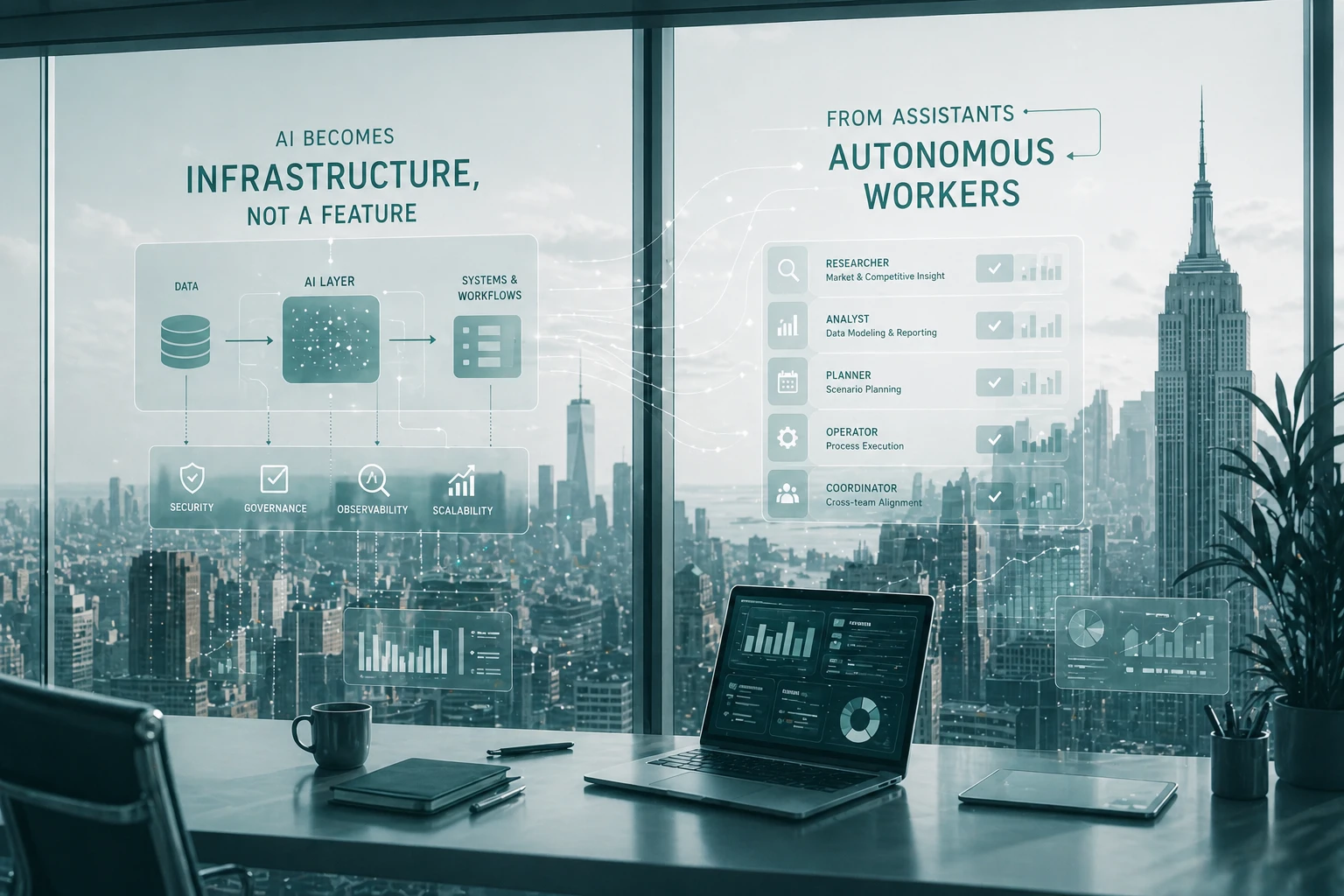
AI Becomes Infrastructure, Not a Feature: From Assistants to Autonomous Workers
By the close of 2025 the AI conversation has shifted twice. First: AI stopped being a feature bolted onto products and started behaving like infrastructure, billed by the hour, depended on like a database, with capital expenditure that rivals national grids. Second: the systems themselves stopped being assistants and started being autonomous workers, with Claude Sonnet 4.5 sustaining 30-hour coding sessions on real tasks and the Model Context Protocol becoming the universal interface that lets agents call tools across vendors. For European enterprises, the consequences for procurement, security, and headcount are now operational.
By the close of 2025 the AI conversation has shifted twice. First: AI stopped being a feature bolted onto products and started behaving like infrastructure, billed by the hour, depended on like a database, with capital expenditure that rivals national grids. Second: the systems themselves stopped being assistants and started being autonomous workers, with Claude Sonnet 4.5 sustaining 30-hour coding sessions on real tasks, OpenAI shipping Atlas as a fully agentic browser, and the Model Context Protocol becoming the universal interface that lets agents call tools across vendors. For European enterprises, the consequences for procurement, security, and headcount are now operational, not theoretical.
For three years the dominant frame for AI in the enterprise was "feature": a copilot bolted onto an existing application, a chat panel beside the document, an assistant the user invokes. That framing has now collapsed. Two distinct shifts during 2025, and especially through the second half, have reset what enterprise AI is and how it has to be governed.
Shift one: AI as infrastructure
By December 2025 the four largest hyperscalers, Microsoft, Google, Meta, Amazon, had each guided AI-related capital expenditure for the year well above $80 billion, with combined 2025 spending crossing $350 billion on infrastructure that is now indistinguishable from utility-scale industrial buildout. The Stargate site in Abilene, Texas, anchored by OpenAI, Oracle, SoftBank, and Abu Dhabi's MGX, came partially online in the autumn. OpenAI signed a roughly $300 billion multi-year compute deal with Oracle in September, a $100 billion Nvidia chip commitment, custom chips with Broadcom, and additional capacity through AMD. AWS Project Rainier, built around more than a million Trainium chips for Anthropic, became operational in mid-2025.
The pricing models followed. By Q4 2025 the leading model providers had effectively converged on three SKUs: per-token usage for inference, reserved-capacity contracts for predictable workloads, and tiered subscriptions for human-facing assistants. That is the pricing shape of cloud, not software. Enterprise procurement teams that started 2025 buying "AI features" finished it negotiating compute commitments, drawing rights, and inference SLAs.
The dependency profile changed too. When AI is a feature, an outage is annoying. When AI sits in production workflows, code review, customer triage, contract analysis, financial close support, an outage is a P1. Through 2025 the major providers all had multi-hour incidents that rippled into customer downtime. Multi-vendor failover and sovereign-cloud or on-prem fallback moved from "nice to have" to architecture requirements.
Shift two: from assistants to autonomous workers
The capability shift was the more visible half. Anthropic released Claude Sonnet 4.5 on 29 September, with the company reporting sustained autonomous coding sessions of more than 30 hours on multi-step engineering tasks, the kind of duration that turns "AI assists a developer" into "developer reviews what AI shipped overnight". Claude Opus 4.5, released on 24 November, pushed the frontier further on long-horizon agentic work and computer use. OpenAI shipped Atlas in October as a browser whose default mode is agentic, the user states a goal and the model navigates, fills forms, and completes tasks. Microsoft Copilot Studio normalised low-code agent construction inside Microsoft 365, and Salesforce continued the Agentforce push that defined its year.
In coding specifically, the change was not subtle. Claude Code, Cursor, GitHub Copilot, OpenAI Codex, and a wave of new tools, Lovable, Replit, Devin, turned much of routine implementation into a queue of agent-completed work. Reports of "vibe coding", "agentic engineering", and "AI-native development" stopped being marketing language and started showing up in engineering performance reviews.
What unified all of this was duration. In 2024 a usable agent loop was tens of seconds. By the end of 2025 it was tens of hours. That single change is what converts an assistant into a worker.
The standardisation moment: MCP
The other precondition for the worker frame was a stable interface. Anthropic's Model Context Protocol, announced in late 2024, became the de-facto standard during 2025. Microsoft, OpenAI, Google, and the broader open-weight ecosystem all added MCP support, and by Q4 2025 most enterprise tools, file systems, ticketing, CRMs, code hosts, observability platforms, exposed MCP servers. The implication is unglamorous but decisive: an agent can now reach into a heterogeneous enterprise toolchain through one protocol rather than a custom integration per vendor.
That is what infrastructure looks like. TCP/IP, HTTP, SQL, none of them were exciting at the moment they standardised, but each compressed years of brittle bespoke work into a substrate that everything else builds on. MCP is doing the same thing for agents.
What this means for European enterprises
For organisations in Switzerland, Germany, and the broader EU, the close of 2025 has four operational consequences.
Procurement is buying compute, not features. The 2026 contract cycle will be denominated in tokens, GPU-hours, and reserved capacity, not seats. Frameworks for measuring and forecasting AI consumption are now as important as the licence terms themselves. Multi-vendor strategies, closed APIs, open-weight families, sovereign hosting, are the default; single-vendor commitments without exit clauses are increasingly hard to defend.
Security has to assume autonomous action. An assistant that suggests text is a different threat surface than an agent that executes work. By Q4 2025 a realistic security posture assumes the agent will read, write, call APIs, and make irreversible decisions in the scope of its credentials. The control point is no longer the prompt; it is the toolset, the credentials, and the audit trail of what the agent actually did. Data-loss prevention, role-aware access at the tool boundary, and full action logging are the minimum bar.
Headcount planning has to model hybrid teams. The Klarna reversal in May 2025 was the cautionary tale; the second half of the year produced the constructive version. Companies that succeeded with autonomous AI did so by redesigning workflows around human review, escalation, and accountability, not by replacing humans wholesale. The right unit of analysis going into 2026 is the hybrid team: people plus the agents they direct, with measurable output per team rather than per head.
Governance is now the precondition, not the afterthought. The MIT NANDA finding in August, that roughly 95 percent of enterprise generative-AI pilots produced no measurable P&L impact, pointed at the same root cause that the agentic shift now amplifies. The 5 percent that succeeded had governance strong enough to let the model into the data and workflows where the value lives. With agents acting autonomously in production, governance is not just a permission for value, it is the control surface that prevents an agent from quietly costing you a customer, a regulator, or a quarter.
The 2026 thesis
The thesis at the end of 2025 is straightforward. Capability is no longer the moat, three or four vendors and an open-weight family will all be at the frontier in 2026. The moat is the operational layer: how an enterprise procures compute, how it standardises agent integration, how it governs autonomous action, and how it composes hybrid teams that produce measurable output. None of those is a model question. All of them are organisation questions.
For European enterprises, that is unfamiliar but not unfavourable terrain. The disciplines that the EU AI Act, FINMA, and Swiss data-protection practice already enforce, risk classification, auditability, documented decision-making, data minimisation, are exactly the disciplines that make agentic AI safe to deploy. The next twelve months will reward organisations that already operate as if AI were infrastructure: governed, measured, multi-vendor, and accountable for outcomes rather than activity.